
Mastering Trigonometry Through Online Courses with Online Math Learning Tools
Let me tell you a little secret: trigonometry doesn’t have to be the monster hiding under your homeschooling bed. I used to think it was this complicated, mystical math realm reserved for rocket scientists and wizards. But guess what? With the right approach and some online math learning tools, trigonometry can become your new best friend. Whether you’re tackling sine, cosine, or tangent, mastering these concepts is totally doable—and even fun.
So, buckle up! I’m going to walk you through how online courses can transform your trigonometry journey from “What on earth is this?” to “I got this!” And yes, I’ll sprinkle in some practical tips, a dash of humor, and a few aha moments along the way.
Why Online Math Learning Tools Are a Game-Changer
If you’re homeschooling, you know how important it is to have resources that fit your family’s rhythm. Online math learning tools offer flexibility, interactive lessons, and a pace that suits your child’s unique learning style. No more dragging through textbooks or staring blankly at static diagrams.
Imagine this: instead of just reading about the unit circle, your student can see it spin, watch how the sine wave moves, and even play with angles in real-time. These tools bring math to life. Plus, many courses include quizzes, games, and instant feedback, which keeps motivation high and frustration low.
Here’s what makes online math learning tools stand out:
Interactive visuals that clarify abstract concepts
Self-paced modules so no one feels rushed or left behind
Access to expert instructors through video lessons and forums
Flexible scheduling that fits around your family’s day
Engaging activities that turn practice into play
If you’re wondering where to start, many platforms offer a trigonometry course online designed specifically for homeschoolers. These courses often integrate faith-based perspectives, which can be a meaningful addition to your child’s education.
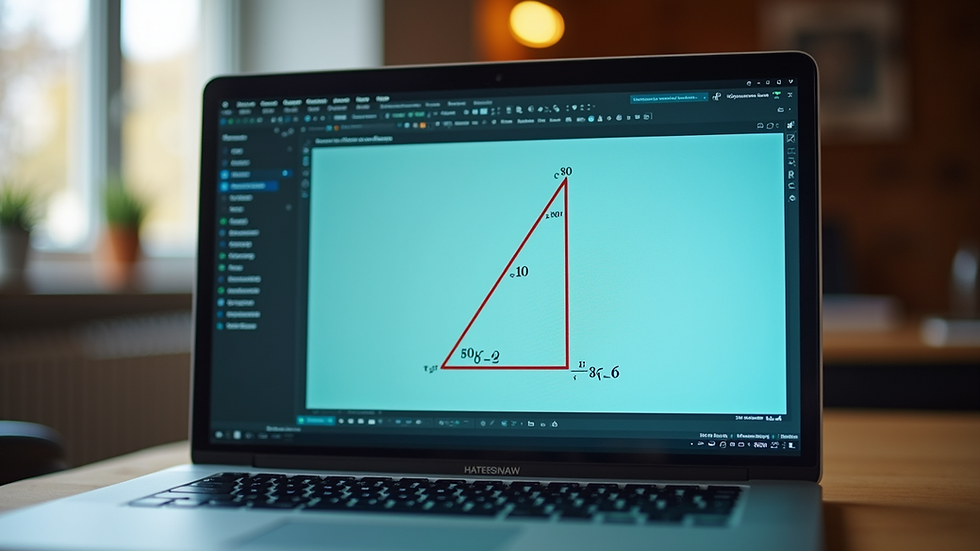
Breaking Down Trigonometry: What You Need to Know First
Before diving into the deep end, it’s helpful to understand the basics. Trigonometry is all about the relationships between the angles and sides of triangles—especially right triangles. You’ll encounter terms like:
Sine (sin): ratio of the opposite side to the hypotenuse
Cosine (cos): ratio of the adjacent side to the hypotenuse
Tangent (tan): ratio of the opposite side to the adjacent side
Sounds simple, right? But it’s easy to get tangled up in the jargon and formulas. That’s why online courses often start with visual aids and real-world examples. For instance, you might explore how trigonometry helps in navigation, architecture, or even music.
One of my favorite tricks is to relate these concepts to everyday objects. Think of a ladder leaning against a wall—that’s a right triangle in action. The angle the ladder makes with the ground? That’s where sine and cosine come into play.
Here’s a quick tip: use a physical model. Grab a ruler, protractor, and some string to create your own triangles. Manipulating these shapes helps cement the concepts far better than just reading about them.
What Level of Math Is Trigonometry?
You might be wondering, “Is trigonometry too advanced for my student right now?” Great question. Trigonometry typically comes after students have a solid grasp of algebra and geometry. Usually, it’s introduced in high school, around grades 9 or 10.
But don’t let that scare you. The beauty of online courses is that they often include review sections to brush up on prerequisite skills. If your child needs a refresher on algebraic expressions or the Pythagorean theorem, these courses have you covered.
Here’s a quick checklist to see if your student is ready:
Comfortable with solving equations and inequalities
Understands basic geometric shapes and properties
Familiar with the Pythagorean theorem
Can work with fractions, decimals, and percentages confidently
If you tick most of these boxes, your student is ready to tackle trigonometry. And if not, no worries—start with the basics and build up gradually. The key is consistent practice and using resources that explain concepts clearly and patiently.

How to Choose the Right Trigonometry Course Online
With so many options out there, picking the perfect trigonometry course online can feel overwhelming. Here’s what I look for when choosing a course for homeschooling:
Accreditation and credibility: Is the course offered by a reputable institution or educator?
Faith integration: Does the course respect and incorporate Christian values?
Interactive content: Are there videos, quizzes, and hands-on activities?
Pacing and flexibility: Can your student learn at their own speed?
Support system: Is there access to instructors or a community for questions?
One of the best parts about online courses is that many offer free trials or sample lessons. Take advantage of these to see if the teaching style clicks with your student.
Also, consider the technology requirements. Some courses need specific software or devices, so make sure your setup is compatible.
Finally, check if the course provides progress tracking and assessments. These help you monitor your child’s growth and identify areas needing extra attention.
Tips for Staying Motivated and Making Trigonometry Stick
Let’s be honest—math can sometimes feel like a slog. But with trigonometry, a little motivation goes a long way. Here are some strategies that worked for me and many homeschooling families:
Set small goals: Break lessons into bite-sized chunks. Celebrate each victory, no matter how small.
Use real-life applications: Show how trigonometry pops up in nature, art, and technology.
Mix it up: Combine video lessons with hands-on activities and games.
Create a study routine: Consistency beats cramming every time.
Encourage questions: Curiosity fuels learning. Don’t shy away from exploring “why” and “how.”
Remember, it’s okay to take breaks and revisit tricky topics. Mastery comes with time and patience.
And hey, if you ever feel stuck, reach out to the course instructors or online communities. Sometimes, a fresh explanation or a different perspective is all you need.
Mastering trigonometry is not just about memorizing formulas or acing tests. It’s about building a foundation for critical thinking and problem-solving that will serve your student well beyond the classroom. With the right online math learning tools and a supportive approach, you can turn this challenging subject into an exciting adventure.
So, why wait? Dive into a trigonometry course online today and watch your student’s confidence—and skills—soar.
Happy learning!


Comments